History
Rokku, Asakusa's stage quarter
How Asakusa became Tokyo's playground, what the Rokku Sixth District was, how war and rebuilding changed it, and where a troupe theatre fits in today.
Find a performance day ↗Quick answer
Asakusa became a pleasure quarter during the Edo period and, for most of the twentieth century, remained one of Tokyo's major pleasure quarters. Its rokku, the Sixth District, was famous for theatres and cinemas such as the Denkikan. The 1945 firebombing heavily damaged the area, which was rebuilt and later overtaken by districts such as Shinjuku, but popular theatre still plays here.
Rice, money and playhouses
Asakusa's rise as a pleasure district in the Edo period owed something to its neighbour, Kuramae, a district of storehouses for the rice used to pay servants of the feudal government. The keepers of those warehouses began trading the rice for money or selling it on at a margin, and many came to have money to spend. Theatres and geisha houses sprang up in nearby Asakusa to meet them.
The Sixth District
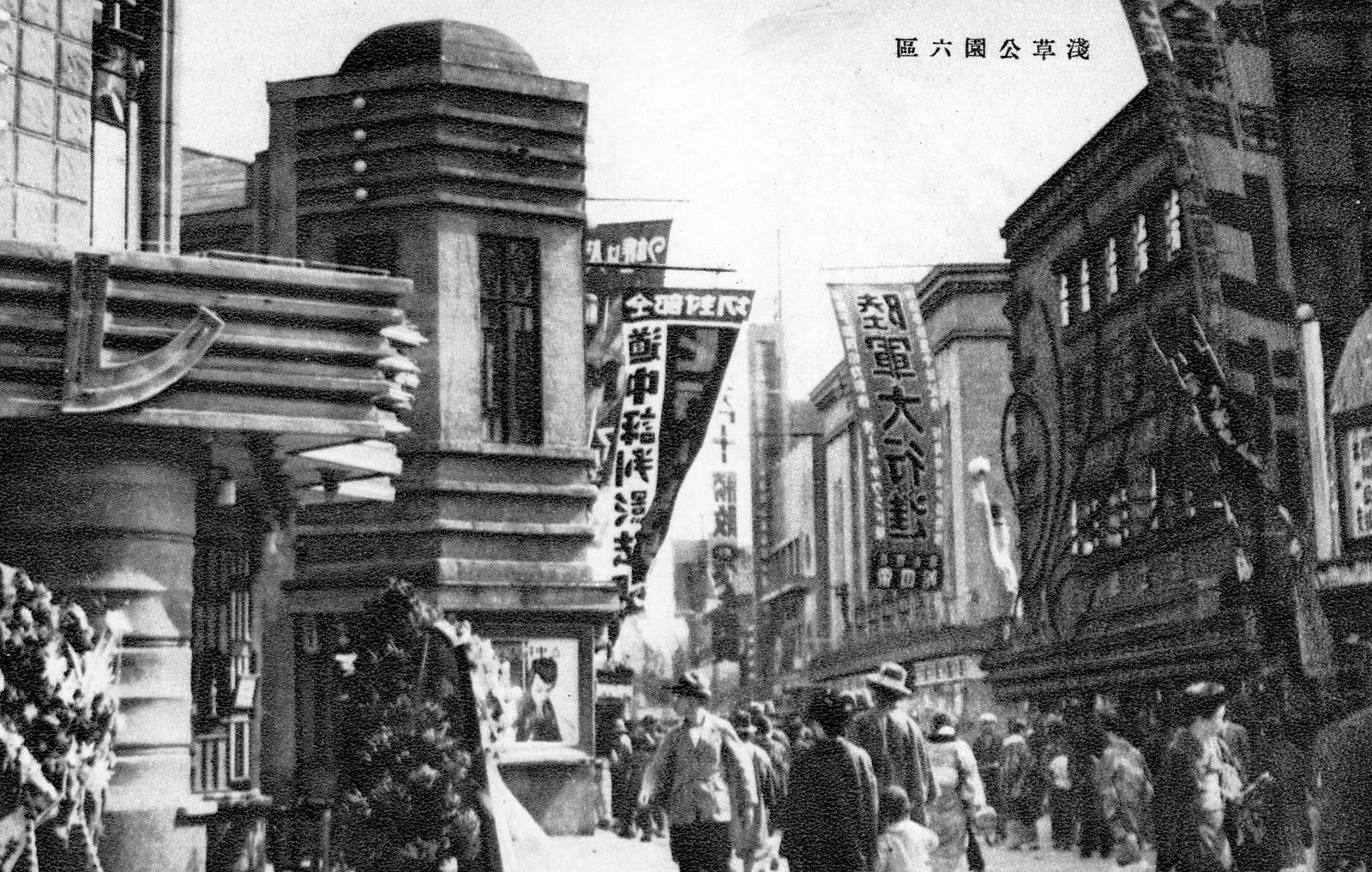
For most of the twentieth century Asakusa remained a major entertainment district, and the rokku, or Sixth District, was in particular famous as a theatre district, home to celebrated cinemas such as the Denkikan. Photographs from around 1930 show its street packed with people beneath tall vertical banners and ornate theatre fronts.
A novel of the golden years
Yasunari Kawabata set his novel The Scarlet Gang of Asakusa, published in 1930, in the district at the height of its fame. Wikipedia describes the book as a vivid portrait of Asakusa's golden years. It remains the best-known literary picture of the quarter, and a good companion read before a visit.
War and rebuilding
The area was heavily damaged by American bombing raids in the Second World War, in particular the firebombing of Tokyo on 10 March 1945. It was rebuilt after the war but was later surpassed by Shinjuku and other districts as the city's pleasure quarter. In 1947, when Tokyo became a metropolis, the old Asakusa ward merged with Shitaya to form today's Taitō ward.
The low city
Asakusa sits at the centre of the area people call Shitamachi, which literally means low city, a name that refers to the low elevation of this old part of Tokyo on the banks of the Sumida River. As the name suggests, Wikipedia describes the area as having a more traditionally Japanese atmosphere than many neighbourhoods in Tokyo. It has many restaurants serving traditional Japanese food, and along Kappabashi a cluster of kitchenware shops draws Tokyo residents looking for kitchen supplies.
Asakusa now
Because so much of Tokyo was destroyed in the war, Asakusa has a greater concentration of buildings from the 1950s and 1960s than most parts of the city. Its neighbourhood theatres specialise in classic Japanese films, and the district still hosts festivals such as the Sanja Matsuri in May. The troupe theatre carries on another strand of the old trade: live popular entertainment, played to a local crowd.
Festivals and the temple
The Sanja Matsuri, held in May, is the most famous of Asakusa's many festivals: portable shrines and floats are carried through the streets to loud shouts over three days. The district's anchor is Sensō-ji, Tokyo's oldest established temple, dedicated to the bodhisattva Kannon, and next to the temple grounds is Hanayashiki, a small amusement park that claims to be the oldest in Japan. Asakusa also hosts an annual Brazilian-style carnival, a reminder that the district has always mixed old and new entertainment.
Where the troupe theatre fits
The theatre describes itself as the last remaining taishū engeki theatre in Tokyo and dates its founding to the Meiji era; those are the theatre's own words. What is clear from any visit is that the form it hosts, popular theatre by touring family troupes, belongs to the same tradition of cheap, close, crowd-pleasing entertainment that made the Sixth District famous.
Read next: Taishū engeki without Japanese
Sources